False 9 Explained: Role, Tactical Impact and Legendary Players
Modern football is a fast-evolving sport where traditional positions frequently blur into fluid, hybrid roles. If you have ever watched a top-tier team dominate possession without using a conventional striker, you are observing one of the game’s finest strategic developments. In this comprehensive guide, we present the False 9 Explained: Role, Tactical Impact and Legendary Players to show you how dropping deep became football’s ultimate tactical masterstroke. By understanding this unique role, you can completely transform how you read modern tactical battles.
Table of Contents
- 1. Demystifying the False 9: Definition and Core Mechanics
- 2. The Tactical Impact: How the Role Manipulates Space
- 3. False 9 Explained: Role, Tactical Impact and Legendary Players in Action
- 4. Traditional Striker vs. False 9: Key Differences Compared
- 5. Historical Evolution and Iconic Pioneers
- 6. False 9 Explained: Role, Tactical Impact and Legendary Players in Modern Coaching
- 7. Tactical Antidotes: How to Neutralize a False 9
- 8. Summary of the False 9 Explained: Role, Tactical Impact and Legendary Players
- 9. Frequently Asked Questions (FAQ)
Demystifying the False 9: Definition and Core Mechanics
In standard football formations, the number nine is typically a target man who leads the attacking line. This player stays high up the pitch, occupies the opposing center-backs, and acts as the focal point for long passes and crosses. However, the modern game demands much more fluid movements to break down highly structured defensive blocks.
Consequently, the role of a false nine completely flips this traditional approach. Instead of staying high to pin the central defenders, a false nine deliberately drops deep into the midfield space between the lines of defense and midfield. This movement creates a vacuum in the opponent’s defensive line, leaving center-backs with a difficult decision to make.
Furthermore, this tactical adjustment turns a standard forward into an extra playmaker. When the forward drops deep, they create a numerical overload in the midfield area. This makes it incredibly difficult for the opposing team to mark players effectively without sacrificing their defensive shape.
Therefore, we can define the false nine as a hybrid playmaker-striker who starts in the center-forward position but routinely abandons it to dictate play and create scoring opportunities for advancing teammates. They are not merely goalscorers; they are the chief architects of their team’s attacking phase.
The Tactical Impact: How the Role Manipulates Space
The primary tactical impact of using a false nine is the manipulation of defensive space. Central defenders are trained to track and mark central strikers within their designated defensive zones. When a striker refuses to stay in those zones, the entire defensive structure begins to unravel.
If a center-back decides to follow the dropping false nine, they leave a massive gap in the defensive line. Consequently, rapid wingers or advancing central midfielders can run directly into this newly vacated space. This specific pattern of play is what makes teams like Manchester City and Arsenal so dangerous when executing fluid rotations.
On the other hand, if the central defenders choose to remain in their defensive block, they grant the false nine complete freedom. The player can receive the ball, turn, and face the defense with plenty of time and space. From this position, they can slide perfectly weighted passes to teammates or take long-range shots.
Ultimately, this tactical dilemma forces the opposing manager to adapt. To protect their central spaces, teams often have to drop into a deep defensive block or deploy a dedicated defensive midfielder to track the player. This defensive adaptation, however, often reduces their ability to launch effective counter-attacks.
False 9 Explained: Role, Tactical Impact and Legendary Players in Action
To fully appreciate this role in action, one must look at how space is manipulated in real-time matches. When the false nine drops deep, they form a passing triangle with the central midfielders. This structural change opens up various vertical passing lanes that do not exist in traditional attacking setups.
In addition, the role requires highly intelligent off-the-ball movements. The false nine must understand exactly when to drop and when to make late runs into the penalty box. These movements are deeply analyzed in modern tactical breakdowns, such as those featured on platforms like Coaches’ Voice, which study how space is manufactured at the highest levels of the sport.
Moreover, the success of this system relies heavily on the behavior of the wide attackers. While the false nine drops into deep midfield zones, the wingers must make diagonal, inside runs to attack the space behind the defense. Without these coordinated movements, the dropping forward simply crowds the midfield without creating any real goal-scoring threat.
Traditional Striker vs. False 9: Key Differences Compared
To understand how this role changes the dynamics of a team, it is useful to compare its attributes directly with those of a traditional target man. Each style of forward has unique tactical advantages depending on the manager’s overall philosophy.
While traditional strikers excel in direct physical duels and aerial battles, the false nine relies heavily on agility, quick scanning, and precise passing. The table below breaks down these fundamental differences across key areas of play:
| Tactical Attribute | Traditional Number 9 (Target Man) | The False Nine (Hybrid Playmaker) |
|---|---|---|
| Primary Zone | Stays high, hovering around the opponent’s penalty box. | Drops deep into the space between defense and midfield lines. |
| Core Objective | Finishing chances, winning aerial duels, and scoring goals. | Creating space, linking play, and manufacturing overloads. |
| Movement Style | Vertical runs behind the defense or physical pinning. | Lateral and dropping movements to draw defenders out. |
| Key Attribute | Physical strength, aerial ability, and clinical finishing. | Elite vision, close control, and precise passing range. |
As illustrated above, these two profiles require entirely different tactical approaches. Many modern coaches choose their starting forward based on the specific defensive weaknesses they aim to exploit in their upcoming opponent.
Historical Evolution and Iconic Pioneers
While many fans view this position as a recent tactical innovation, its roots actually date back to the early 20th century. Over the decades, several visionary coaches and highly intelligent players have refined this role to dismantle the most stubborn defensive systems of their eras.
The earliest documented use of a dropping forward occurred in the 1930s with the Austrian “Wunderteam.” The legendary forward Matthias Sindelar frequently dropped deep into midfield to orchestrate play, leaving robust defenders completely confused about whether to mark him or hold their lines.
In the 1950s, Hungary’s legendary “Golden Team” utilized Nándor Hidegkuti in a similar fashion. During their historic 6-3 victory over England at Wembley in 1953, Hidegkuti’s deep-dropping movement completely shattered England’s rigid WM system, proving the immense tactical power of strikerless formations on the global stage.
Decades later, Italian playmaker Francesco Totti revolutionized the role under manager Luciano Spalletti at AS Roma. Playing in an innovative 4-6-0 system, Totti combined his elite playmaking vision with a natural eye for goal, scoring enough to win the European Golden Shoe while operating as a deep-lying forward.
However, the absolute pinnacle of this role was reached during Pep Guardiola’s reign at FC Barcelona. By moving a young Lionel Messi from the right wing to the center, Guardiola created arguably the most dominant club side in football history, using Messi’s unmatched dribbling and vision to dismantle teams worldwide.
False 9 Explained: Role, Tactical Impact and Legendary Players in Modern Coaching
In contemporary football, elite managers continue to adapt this tactical tool to bypass modern pressing systems. Rather than relying on a single fixed style, coaches now merge the false nine position with other tactical concepts to keep their build-up play highly unpredictable.
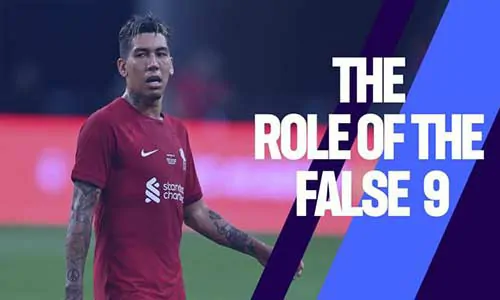
For instance, Jurgen Klopp’s highly successful Liverpool side relied heavily on Roberto Firmino to facilitate their high-pressing system. Firmino was not a traditional high-scoring striker; instead, his defensive work rate and clever movements created the space that allowed Mohamed Salah and Sadio Mane to score heavily from wide positions.
Furthermore, we have seen international teams adapt this concept during major tournaments. For example, during Spain’s dominant era, Vicente del Bosque frequently deployed midfielder Cesc Fàbregas as a forward. This tactical decision helped Spain maintain complete control over possession and win Euro 2012 without using a natural striker.
In recent seasons, we have witnessed a fascinating revival of the role. Managers like Mikel Arteta at Arsenal have used Kai Havertz in a hybrid fashion, combining physical presence with intelligent dropping movements. This demonstrates that the role continues to adapt to the physical demands of modern league play.
Tactical Antidotes: How to Neutralize a False 9
Despite its immense effectiveness, modern coaches have developed several smart ways to defend against a dropping forward. To stop a false nine, a defensive unit must maintain excellent communication and high discipline across all lines of play.
One highly effective counter-strategy is implementing a strict zonal marking scheme instead of a man-marking defense. By defending zones rather than specific players, central defenders can hand over the dropping forward to their defensive midfielders, ensuring no massive gaps open up in the backline.
In addition, teams can deploy a highly disciplined low block. By keeping the space between the midfield and defensive lines extremely compact, they deny the false nine the room needed to turn and build plays. This defensive style, however, requires immense concentration for the full ninety minutes.
Ultimately, modern teams also use aggressive counter-pressing to stop the ball from reaching the playmaker in the first place. By cutting off the passing lanes to the forward, defenders can starve them of possession and completely neutralize their impact on the game.
Summary of the False 9 Explained: Role, Tactical Impact and Legendary Players
To summarize, the false nine remains one of the most brilliant and influential tactical concepts in the history of football. From the early days of Matthias Sindelar and Nándor Hidegkuti to the modern mastery of Lionel Messi and Roberto Firmino, this role has consistently challenged how teams organize their defensive units.
By dropping deep and transforming from a striker into a playmaker, the false nine creates a numerical advantage in midfield and opens up vital spaces for teammates to exploit. Whether you are an aspiring coach, a dedicated player, or an analytical fan, understanding these tactical nuances will vastly improve your appreciation of the beautiful game.
If you want to keep up with the latest tactical trends in global tournaments, check out the tactical analyses and resources available on the official FIFA website. How do you think the role will evolve in the coming years? Share your thoughts with us in the comments section below!
Frequently Asked Questions (FAQ)
What is the main difference between a False 9 and a Traditional 9?
A traditional number nine stays high up the pitch to pin the opposition’s defenders and finish chances. In contrast, a false nine drops deep into midfield to link play, overload central areas, and create space for other attacking players.
Who is widely considered the best False 9 in football history?
Lionel Messi under Pep Guardiola at FC Barcelona is widely considered the gold standard for this role. His incredible combination of elite dribbling, pinpoint passing, and clinical finishing made him virtually unstoppable in this system.
How do defenders counter a False 9?
Defenders typically counter this system by using zonal marking instead of man-marking, maintaining a compact low block, or deploying a dedicated defensive midfielder to monitor the spaces between the lines.
Does a False 9 team need high-scoring wingers?
Yes. Because the central forward drops deep and leaves the penalty box vacant, the wingers must make intelligent diagonal runs inside to exploit that space and serve as the team’s primary goalscorers.
Can any midfielder play as a False 9?
While midfielders have the passing ability for this role, they also need excellent spatial awareness, the athletic ability to make late runs into the box, and clinical finishing skills when scoring opportunities arise.
Is the False 9 role still used in modern football today?
Yes, the role has evolved and is still used today. Teams like Arsenal with Kai Havertz and various national teams utilize hybrid variations of the role to break down highly organized modern defenses.