UEFA Champions League Winners List: Every Champion Since 1956
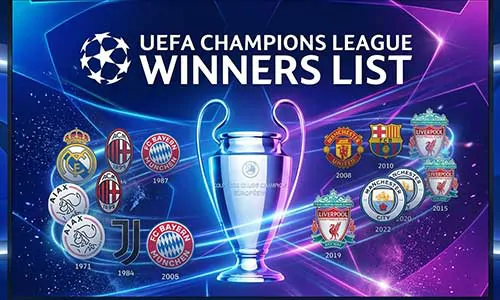
For football enthusiasts worldwide, nothing matches the prestige, drama, and history of Europe’s premier club football tournament. If you are looking to explore the rich legacy of this legendary tournament, this definitive UEFA Champions League Winners List: Every Champion Since 1956 is your ultimate resource. From the early dominance of Real Madrid in the 1950s to the dramatic tactical masterclasses of the modern era, this tournament has consistently produced the greatest moments in sporting history. Consequently, keeping track of every champion highlights the evolution of tactical genius, legendary players, and shifting footballing empires across the European continent.
Over the decades, this competition has transformed from a straightforward knockout cup into a multi-billion-dollar global spectacle. Initially known as the European Champion Clubs’ Cup, the tournament underwent a massive rebranding in 1992. Recently, the format evolved once again to accommodate the highly competitive Swiss-system league phase. Whether you are a casual observer or a dedicated football historian, studying the UEFA Champions League Winners List: Every Champion Since 1956 provides invaluable context on how modern football became the global phenomenon it is today.
Table of Contents
- 1. The Genesis: The European Cup Era (1956–1992)
- 2. The Modern Era: Rebranding the UEFA Champions League (1992–2024)
- 3. The Dawn of the Swiss Format (2024–Present)
- 4. UEFA Champions League Winners List: Every Champion Since 1956
- 5. Clubs with the Most Titles
- 6. National Dominance: Winning Countries
- 7. Frequently Asked Questions (FAQ)
1. The Genesis: The European Cup Era (1956–1992)
The roots of Europe’s elite club competition trace back to the mid-1950s when French journalists Gabriel Hanot and Jacques Ferran proposed a continental tournament. Consequently, the European Champion Clubs’ Cup was born in 1955, designed specifically to pit the domestic league champions of Europe against one another. In those early days, the tournament operated as a pure, straight-knockout competition, leaving no margin for error.
Real Madrid immediately established an unprecedented stranglehold on the trophy. Led by legendary icons Alfredo Di Stéfano, Ferenc Puskás, and Francisco Gento, the Spanish giants captured the first five consecutive editions from 1956 to 1960. Their 7-3 victory over Eintracht Frankfurt in the 1960 final remains widely regarded as one of the greatest matches ever played. Therefore, any analysis of the UEFA Champions League Winners List: Every Champion Since 1956 must recognize Real Madrid as the foundational architects of this tournament’s global prestige.
However, the 1960s brought a welcome diversification of the winner’s podium. Portuguese powerhouse Benfica broke Real Madrid’s monopoly, winning back-to-back titles in 1961 and 1962 under the brilliant management of Béla Guttmann. Shortly thereafter, the tactical innovation of Catenaccio—a highly organized, defensive-minded system—propelled Italian giants AC Milan and Inter Milan to continental glory. Meanwhile, Celtic made history in 1967 as the first British club to win the cup, earning the moniker “The Lisbon Lions” by fielding a team entirely born within 30 miles of Glasgow.
The early 1970s witnessed a tactical revolution led by Ajax and their pioneering philosophy of “Total Football.” Spearheaded by the incomparable Johan Cruyff, Ajax captured three consecutive titles from 1971 to 1973. This era of fluid, possession-based football was immediately followed by a three-year period of dominance by Germany’s Bayern Munich, marshaled by captain Franz Beckenbauer and prolific goalscorer Gerd Müller. During this golden age of football, tactical frameworks were redefined, leaving a permanent legacy on the sport.
Furthermore, the late 1970s and early 1980s marked a golden era of English dominance. Liverpool, Nottingham Forest, and Aston Villa ensured that the trophy resided in England for an astonishing seven out of eight seasons between 1977 and 1984. Specifically, Nottingham Forest’s back-to-back triumphs under Brian Clough remain one of the most remarkable underdog stories in sporting history. This legendary English era eventually came to an end following the tragic events of the Heysel Stadium disaster in 1985, which resulted in a five-year ban for English clubs in Europe.
In the final years of the old European Cup format, tactical pragmatism and defensive resilience returned to the forefront. Clubs like Steaua București of Romania (1986) and Red Star Belgrade of Yugoslavia (1991) secured historic victories, showcasing that elite footballing talent was distributed across all corners of Europe. Ultimately, the stage was set for a massive commercial and structural transformation that would change European football forever.
2. The Modern Era: Rebranding the UEFA Champions League (1992–2024)
By the early 1990s, the growing demands of television networks and top clubs prompted UEFA to completely restructure the competition. Consequently, in 1992, the tournament was officially rebranded as the UEFA Champions League. This monumental change introduced a group stage format, guaranteeing more high-profile matches between elite clubs and significantly boosting commercial revenue. As a result, the competition transformed from a simple tournament into a global entertainment brand.
The inaugural rebranded season in 1992-93 was won by French side Marseille. However, the subsequent decade was characterized by intense rivalries and iconic matches. AC Milan’s devastating 4-0 thrashing of Johan Cruyff’s Barcelona “Dream Team” in 1994 demonstrated the sheer tactical evolution of the Italian game under Fabio Capello. Meanwhile, Ajax’s young golden generation claimed the title in 1995, proving that youth academy products could still conquer the continent.
In addition, the 1999 final between Manchester United and Bayern Munich at the Camp Nou became the epitome of Champions League drama. Trailing 1-0 in stoppage time, Manchester United scored two historic goals in a matter of minutes to secure an unprecedented continental treble. This dramatic victory solidified the tournament’s reputation as a theater of unpredictable, high-stakes drama where matches are never truly over until the final whistle blows.
The turn of the millennium welcomed the famous “Galácticos” era of Real Madrid. Zinedine Zidane’s stunning, physics-defying volley in the 2002 final against Bayer Leverkusen remains one of the most iconic goals ever scored in the competition. However, the mid-2000s belonged to tactical masterminds like Rafael Benítez, who orchestrated the “Miracle of Istanbul” in 2005. In that unforgettable final, Liverpool overcame a 3-0 halftime deficit against a star-studded AC Milan side to win on penalties, completing the greatest comeback in the competition’s history.
Between 2009 and 2011, Barcelona under Pep Guardiola played what many consider to be the most beautiful football ever witnessed. Powered by the legendary midfield trio of Sergio Busquets, Xavi, and Andrés Iniesta, and spearheading the attack with Lionel Messi, Barcelona redefined modern possession football. Their dominant victories over Manchester United in both the 2009 and 2011 finals established a blueprint for modern tactical systems.
Ultimately, the 2010s would be completely dominated by Spanish clubs, and specifically, Real Madrid. Under the calm guidance of Zinedine Zidane, Real Madrid achieved the seemingly impossible modern “three-peat” by winning the title in 2016, 2017, and 2018. Led by the competition’s all-time top scorer, Cristiano Ronaldo, they proved that big-game experience and elite mentality are often the deciding factors in tournament football. Real Madrid eventually extended their supremacy by capturing their 14th title in 2022 and their 15th title in 2024, cementting their place as the undisputed kings of Europe.
3. The Dawn of the Swiss Format (2024–Present)
In response to changing viewing habits and the threat of breakaway competitions, UEFA introduced its most radical structural change for the 2024–25 season. The traditional 32-team group stage was completely replaced by a single, comprehensive 36-team league phase, commonly known as the “Swiss Model.” In this format, teams play eight matches against eight different opponents, with the top eight progressing directly to the round of 16, and the next 16 entering a playoff round.
This structural change was designed to ensure more high-stakes matches between elite clubs early in the tournament. Consequently, the physical and tactical demands placed on squads reached unprecedented levels. The inaugural season of this new format culminated in a historic milestone. Paris Saint-Germain, under the tactical guidance of Luis Enrique, captured their first-ever Champions League title in 2025 by defeating Inter Milan 5-0 in a masterfully executed final in Munich.
Remarkably, the French champions did not stop there. In the subsequent 2025-26 season, Paris Saint-Germain proved their continental dominance by retaining their crown. In a tense and tactical final held in Budapest, PSG defeated Arsenal on penalties after a hard-fought 1-1 draw. This historic back-to-back achievement demonstrated how quickly footballing power dynamics can shift in this modern, highly demanding era.
4. UEFA Champions League Winners List: Every Champion Since 1956
To help you navigate this immense history, the comprehensive table below outlines every single final since the tournament’s inception. Specifically, this detailed UEFA Champions League Winners List: Every Champion Since 1956 includes the winners, runners-up, final scorelines, and the iconic venues that hosted these historic clashes.
| Season | Winner | Runner-up | Score | Venue |
|---|---|---|---|---|
| 1955–56 | Real Madrid (Spain) | Reims (France) | 4–3 | Parc des Princes, Paris |
| 1956–57 | Real Madrid (Spain) | Fiorentina (Italy) | 2–0 | Santiago Bernabéu, Madrid |
| 1957–58 | Real Madrid (Spain) | AC Milan (Italy) | 3–2 (AET) | Heysel Stadium, Brussels |
| 1958–59 | Real Madrid (Spain) | Reims (France) | 2–0 | Neckarstadion, Stuttgart |
| 1959–60 | Real Madrid (Spain) | Eintracht Frankfurt (Germany) | 7–3 | Hampden Park, Glasgow |
| 1960–61 | Benfica (Portugal) | Barcelona (Spain) | 3–2 | Wankdorf Stadium, Bern |
| 1961–62 | Benfica (Portugal) | Real Madrid (Spain) | 5–3 | Olympisch Stadion, Amsterdam |
| 1962–63 | AC Milan (Italy) | Benfica (Portugal) | 2–1 | Wembley Stadium, London |
| 1963–64 | Inter Milan (Italy) | Real Madrid (Spain) | 3–1 | Praterstadion, Vienna |
| 1964–65 | Inter Milan (Italy) | Benfica (Portugal) | 1–0 | San Siro, Milan |
| 1965–66 | Real Madrid (Spain) | Partizan (Yugoslavia) | 2–1 | Heysel Stadium, Brussels |
| 1966–67 | Celtic (Scotland) | Inter Milan (Italy) | 2–1 | Estádio Nacional, Lisbon |
| 1967–68 | Manchester United (England) | Benfica (Portugal) | 4–1 (AET) | Wembley Stadium, London |
| 1968–69 | AC Milan (Italy) | Ajax (Netherlands) | 4–1 | Santiago Bernabéu, Madrid |
| 1969–70 | Feyenoord (Netherlands) | Celtic (Scotland) | 2–1 (AET) | San Siro, Milan |
| 1970–71 | Ajax (Netherlands) | Panathinaikos (Greece) | 2–0 | Wembley Stadium, London |
| 1971–72 | Ajax (Netherlands) | Inter Milan (Italy) | 2–0 | De Kuip, Rotterdam |
| 1972–73 | Ajax (Netherlands) | Juventus (Italy) | 1–0 | Red Star Stadium, Belgrade |
| 1973–74 | Bayern Munich (Germany) | Atlético Madrid (Spain) | 4–0 (Replay) | Heysel Stadium, Brussels |
| 1974–75 | Bayern Munich (Germany) | Leeds United (England) | 2–0 | Parc des Princes, Paris |
| 1975–76 | Bayern Munich (Germany) | Saint-Étienne (France) | 1–0 | Hampden Park, Glasgow |
| 1976–77 | Liverpool (England) | B. Mönchengladbach (Germany) | 3–1 | Stadio Olimpico, Rome |
| 1977–78 | Liverpool (England) | Club Brugge (Belgium) | 1–0 | Wembley Stadium, London |
| 1978–79 | Nottingham Forest (England) | Malmö FF (Sweden) | 1–0 | Olympiastadion, Munich |
| 1979–80 | Nottingham Forest (England) | Hamburger SV (Germany) | 1–0 | Santiago Bernabéu, Madrid |
| 1980–81 | Liverpool (England) | Real Madrid (Spain) | 1–0 | Parc des Princes, Paris |
| 1981–82 | Aston Villa (England) | Bayern Munich (Germany) | 1–0 | De Kuip, Rotterdam |
| 1982–83 | Hamburger SV (Germany) | Juventus (Italy) | 1–0 | Olympic Stadium, Athens |
| 1983–84 | Liverpool (England) | AS Roma (Italy) | 1–1 (4–2 pens) | Stadio Olimpico, Rome |
| 1984–85 | Juventus (Italy) | Liverpool (England) | 1–0 | Heysel Stadium, Brussels |
| 1985–86 | Steaua București (Romania) | Barcelona (Spain) | 0–0 (2–0 pens) | Sánchez Pizjuán, Seville |
| 1986–87 | FC Porto (Portugal) | Bayern Munich (Germany) | 2–1 | Praterstadion, Vienna |
| 1987–88 | PSV Eindhoven (Netherlands) | Benfica (Portugal) | 0–0 (6–5 pens) | Neckarstadion, Stuttgart |
| 1988–89 | AC Milan (Italy) | Steaua București (Romania) | 4–0 | Camp Nou, Barcelona |
| 1989–90 | AC Milan (Italy) | Benfica (Portugal) | 1–0 | Praterstadion, Vienna |
| 1990–91 | Red Star Belgrade (Yugoslavia) | Marseille (France) | 0–0 (5–3 pens) | Stadio San Nicola, Bari |
| 1991–92 | Barcelona (Spain) | Sampdoria (Italy) | 1–0 (AET) | Wembley Stadium, London |
| 1992–93 | Marseille (France) | AC Milan (Italy) | 1–0 | Olympiastadion, Munich |
| 1993–94 | AC Milan (Italy) | Barcelona (Spain) | 4–0 | Olympic Stadium, Athens |
| 1994–95 | Ajax (Netherlands) | AC Milan (Italy) | 1–0 | Ernst-Happel-Stadion, Vienna |
| 1995–96 | Juventus (Italy) | Ajax (Netherlands) | 1–1 (4–2 pens) | Stadio Olimpico, Rome |
| 1996–97 | Borussia Dortmund (Germany) | Juventus (Italy) | 3–1 | Olympiastadion, Munich |
| 1997–98 | Real Madrid (Spain) | Juventus (Italy) | 1–0 | Amsterdam ArenA, Amsterdam |
| 1998–99 | Manchester United (England) | Bayern Munich (Germany) | 2–1 | Camp Nou, Barcelona |
| 1999–2000 | Real Madrid (Spain) | Valencia (Spain) | 3–0 | Stade de France, Saint-Denis |
| 2000–01 | Bayern Munich (Germany) | Valencia (Spain) | 1–1 (5–4 pens) | San Siro, Milan |
| 2001–02 | Real Madrid (Spain) | Bayer Leverkusen (Germany) | 2–1 | Hampden Park, Glasgow |
| 2002–03 | AC Milan (Italy) | Juventus (Italy) | 0–0 (3–2 pens) | Old Trafford, Manchester |
| 2003–04 | FC Porto (Portugal) | Monaco (France) | 3–0 | Arena AufSchalke, Gelsenkirchen |
| 2004–05 | Liverpool (England) | AC Milan (Italy) | 3–3 (3–2 pens) | Atatürk Olympic Stadium, Istanbul |
| 2005–06 | Barcelona (Spain) | Arsenal (England) | 2–1 | Stade de France, Saint-Denis |
| 2006–07 | AC Milan (Italy) | Liverpool (England) | 2–1 | Olympic Stadium, Athens |
| 2007–08 | Manchester United (England) | Chelsea (England) | 1–1 (6–5 pens) | Luzhniki Stadium, Moscow |
| 2008–09 | Barcelona (Spain) | Manchester United (England) | 2–0 | Stadio Olimpico, Rome |
| 2009–10 | Inter Milan (Italy) | Bayern Munich (Germany) | 2–0 | Santiago Bernabéu, Madrid |
| 2010–11 | Barcelona (Spain) | Manchester United (England) | 3–1 | Wembley Stadium, London |
| 2011–12 | Chelsea (England) | Bayern Munich (Germany) | 1–1 (4–3 pens) | Allianz Arena, Munich |
| 2012–13 | Bayern Munich (Germany) | Borussia Dortmund (Germany) | 2–1 | Wembley Stadium, London |
| 2013–14 | Real Madrid (Spain) | Atlético Madrid (Spain) | 4–1 (AET) | Estádio da Luz, Lisbon |
| 2014–15 | Barcelona (Spain) | Juventus (Italy) | 3–1 | Olympiastadion, Berlin |
| 2015–16 | Real Madrid (Spain) | Atlético Madrid (Spain) | 1–1 (5–3 pens) | San Siro, Milan |
| 2016–17 | Real Madrid (Spain) | Juventus (Italy) | 4–1 | Principality Stadium, Cardiff |
| 2017–18 | Real Madrid (Spain) | Liverpool (England) | 3–1 | NSC Olimpiyskiy, Kyiv |
| 2018–19 | Liverpool (England) | Tottenham Hotspur (England) | 2–0 | Metropolitano Stadium, Madrid |
| 2019–20 | Bayern Munich (Germany) | Paris Saint-Germain (France) | 1–0 | Estádio da Luz, Lisbon |
| 2020–21 | Chelsea (England) | Manchester City (England) | 1–0 | Estádio do Dragão, Porto |
| 2021–22 | Real Madrid (Spain) | Liverpool (England) | 1–0 | Stade de France, Saint-Denis |
| 2022–23 | Manchester City (England) | Inter Milan (Italy) | 1–0 | Atatürk Olympic Stadium, Istanbul |
| 2023–24 | Real Madrid (Spain) | Borussia Dortmund (Germany) | 2–0 | Wembley Stadium, London |
| 2024–25 | Paris Saint-Germain (France) | Inter Milan (Italy) | 5–0 | Allianz Arena, Munich |
| 2025–26 | Paris Saint-Germain (France) | Arsenal (England) | 1–1 (4–3 pens) | Puskás Aréna, Budapest |
5. Clubs with the Most Titles
Analyzing the official UEFA Champions League Winners List: Every Champion Since 1956 reveals that while many have tried to scale the mountain, only a select group of clubs have dominated the landscape. Understanding these hierarchies of success provides a fascinating view of sporting dynasties.
The following clubs stand as the most decorated institutions in the history of the competition:
- Real Madrid (15 Titles): The undisputed kings of European football. Their longevity across different generations—from the 1950s team to the modern era of the 2010s and 2020s—remains unmatched.
- AC Milan (7 Titles): Italy’s most successful representative. Their squads in the late 1980s under Arrigo Sacchi and the mid-2000s under Carlo Ancelotti are legendary.
- Bayern Munich (6 Titles): The pinnacle of German football efficiency and dominance. They achieved their greatest triumph during their mid-70s treble and reinforced their legacy with treble-winning squads in 2013 and 2020.
- Liverpool (6 Titles): England’s most successful club in Europe. From the tactical setups of Bob Paisley to the high-pressing intensity of Jürgen Klopp, the Anfield club is synonymous with European nights.
- Barcelona (5 Titles): Catalonian giants whose modern era revolutionized tactical thinking. Their peak years from 2006 to 2015 brought some of the most fluid football ever seen in Europe.
- Ajax (4 Titles): The historical breeding ground of elite tactical systems. Their three-peat in the 1970s changed modern football tactics forever.
- Manchester United & Inter Milan (3 Titles each): Historic giants who have reached the pinnacle of the sport through different tactical approaches.
- Paris Saint-Germain (2 Titles): The latest additions to the elite multi-title tier. Their back-to-back triumphs under the new format in 2025 and 2026 have shattered decades of near-misses.
Moreover, several historical surprises can be found when inspecting the full UEFA Champions League Winners List: Every Champion Since 1956. For instance, Nottingham Forest has won the European Cup twice (1979, 1980), which actually makes them more successful in Europe than they are in their domestic league phase of modern English football history. This emphasizes the unpredictable magic of European competition.
6. National Dominance: Winning Countries
Ultimately, individual club success directly contributes to national pride. Consequently, the battle for continental supremacy is often analyzed on a country-by-country basis. When we evaluate the cumulative achievements on the UEFA Champions League Winners List: Every Champion Since 1956, distinct patterns of national dominance emerge.
Specifically, Spanish clubs have amassed the most trophies, largely propelled by the consistent excellence of Real Madrid and the golden periods of Barcelona. In contrast, English clubs boast the highest number of unique winning teams (including Liverpool, Manchester United, Nottingham Forest, Chelsea, Aston Villa, and Manchester City), demonstrating the depth and competitive nature of English football.
Meanwhile, Italy’s rich tactical heritage has kept them highly competitive, although they have experienced dry spells in recent decades. Germany’s challenge is consistently led by Bayern Munich, supported historically by Borussia Dortmund and Hamburger SV. France, which struggled for decades with only Marseille’s 1993 title, has recently surged forward due to the continuous domestic investment and tactical evolution at Paris Saint-Germain.
For more detailed statistics and historical match-by-match breakdowns, you can consult the official UEFA Champions League Official Website or explore comprehensive datasets on Wikipedia’s European Cup Finals History.
7. Frequently Asked Questions (FAQ)
Q1: Which club has won the most Champions League titles?
Real Madrid is the most successful club in the history of the competition, having won a record-extending 15 titles since its inception in 1956.
Q2: What is the difference between the European Cup and the Champions League?
The European Cup (1956–1992) was a pure knockout competition featuring only domestic league champions. The rebranded UEFA Champions League (1992–present) introduced group stages and multiple entrants from top leagues, maximizing matches and commercial revenue.
Q3: Who won the first Champions League in 1956?
Real Madrid won the inaugural tournament in 1956, defeating French club Reims 4-3 in a thrilling final held at the Parc des Princes in Paris.
Q4: How did the Swiss system change the tournament format in 2024?
Introduced in the 2024–25 season, the Swiss model replaced the traditional group stage with a single 36-team league phase. Each team plays eight games against eight different opponents, with the top eight ranking clubs advancing directly to the Round of 16.
Q5: Who won the Champions League finals in 2025 and 2026?
Paris Saint-Germain achieved historic back-to-back victories. They won their first-ever title in 2025 by defeating Inter Milan 5-0 in Munich, and successfully defended their crown in 2026 by defeating Arsenal on penalties in Budapest.
Q6: Has any club won three Champions League titles in a row?
Yes, in the modern Champions League era, Real Madrid achieved a legendary “three-peat” by winning in 2016, 2017, and 2018. Historically, Ajax (1971–1973) and Bayern Munich (1974–1976) have also achieved three consecutive titles, while Real Madrid won the first five (1956–1960).